Fall 2025
Columbia GSAPP
Columbia GSAPP
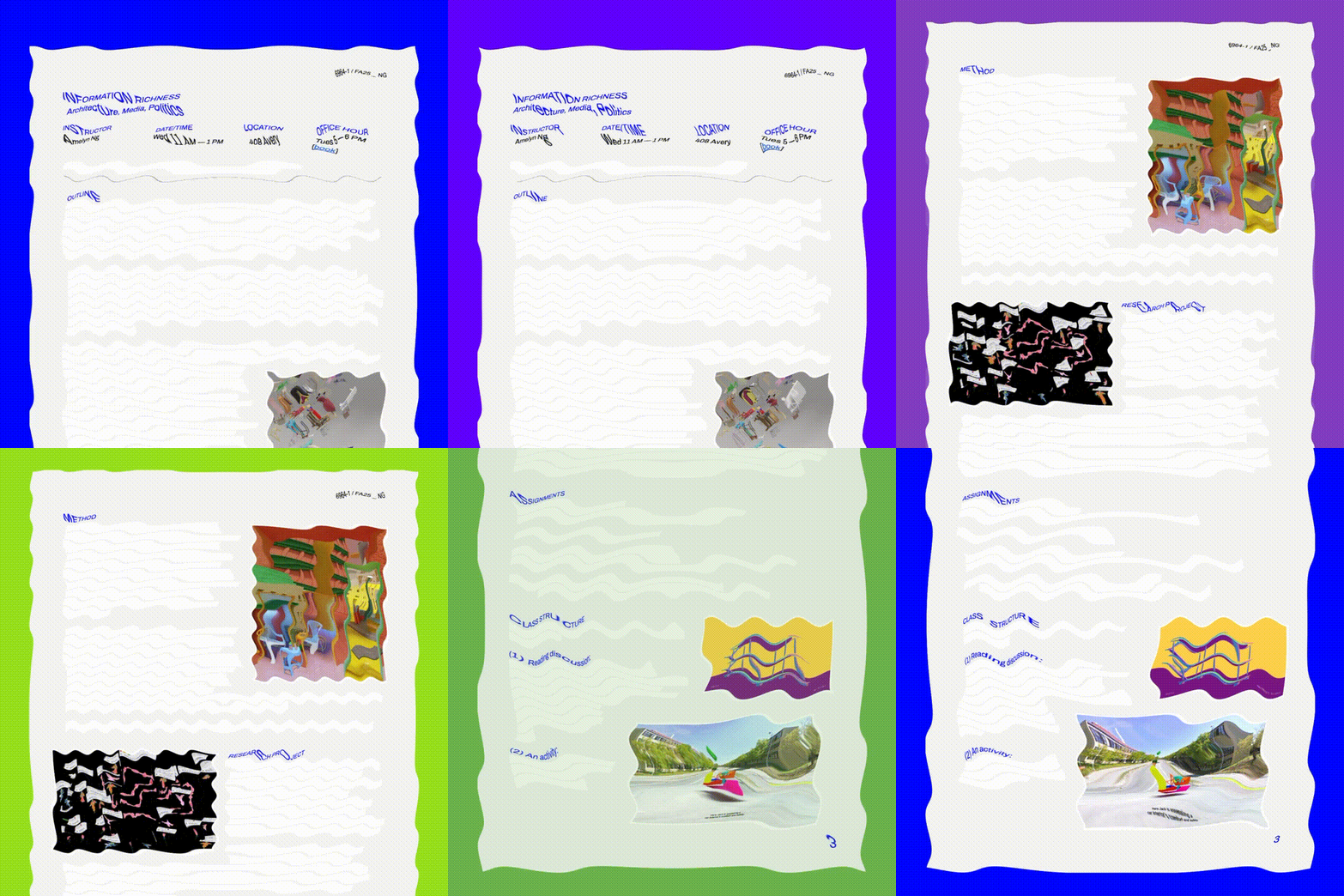
INFORMATION RICHNESS: Architecture, Media, Politics
Representation elective seminar
Representation elective seminar
This research and representation seminar examines architectural media in an information-rich world — one in which technology is no longer new but mundane, entrenched, and resource-intensive.
Information richness is not simply a passive condition of possessing data, but points toward a highly mediated assemblage that has bearing on society’s engagements with the world. Instead of establishing some determinate definition of technology or a list of tutorials to “master,” this seminar delves into concepts, techniques, conventions, and affects of architectural representation by entangling them with a systemic view of media, technology, and visual culture.
Information richness is not simply a passive condition of possessing data, but points toward a highly mediated assemblage that has bearing on society’s engagements with the world. Instead of establishing some determinate definition of technology or a list of tutorials to “master,” this seminar delves into concepts, techniques, conventions, and affects of architectural representation by entangling them with a systemic view of media, technology, and visual culture.
IMAGES COMING SOON
Spring 2025
Columbia GSAPP
Columbia GSAPP
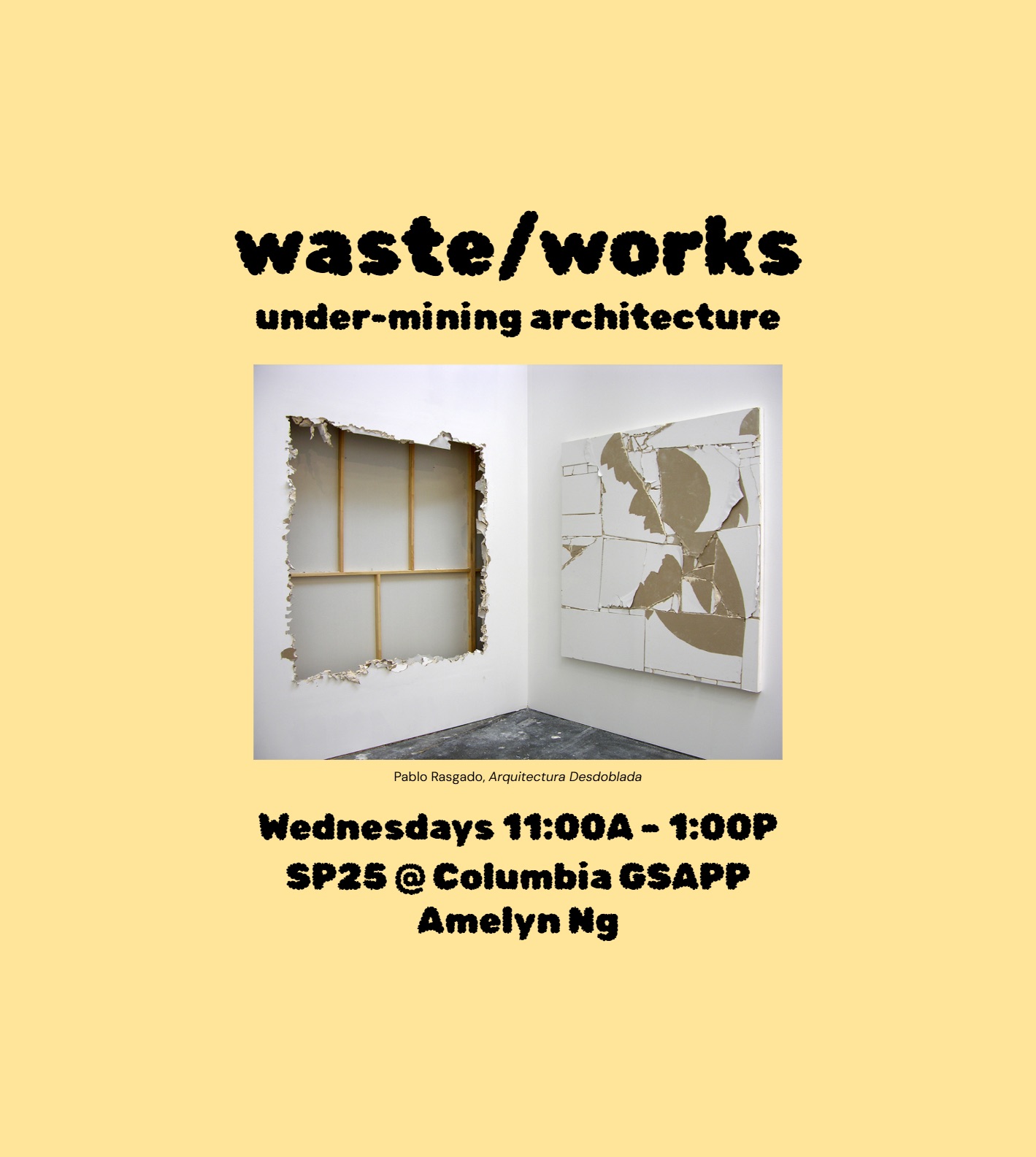
WASTE/WORKS: Under-mining architecture
Representation elective seminar
Representation elective seminar
Construction in its current form has been known as a growth industry reliant on extractive practices, on-demand materials, and cultures of demolition. With landfills bursting at the seams with the stuff of buildings, it is no longer enough for the work of architecture to remain insulated at the front end of the supply chain.
WASTE/WORKS seeks to revalue materials differently, through digital and physical means. By attending to the debris, offcuts, stockpiles, and secondary material economies of architecture, WASTE/WORKS dreams of a post-extraction world where product is not the key economic driver, but rather, practices that act on waste systems and reorient material relations through aesthetic registers.
WASTE/WORKS seeks to revalue materials differently, through digital and physical means. By attending to the debris, offcuts, stockpiles, and secondary material economies of architecture, WASTE/WORKS dreams of a post-extraction world where product is not the key economic driver, but rather, practices that act on waste systems and reorient material relations through aesthetic registers.
IMAGES COMING SOON
Spring 2025
Columbia GSAPP
Columbia GSAPP
Architectural Drawing and Representation II (ADR2)
Core MArch First Year Representation course
Core MArch First Year Representation course
ADR 2 focuses on drawing and modeling as data-based processes (the underlying structure of decisions that inform a drawing or model). You will have the opportunity to intersect spatial and geometric representation with information, including temporal, environmental, social, material, historical, and sequential data.
Computational processes can help us study, test, and propose design conditions as systems, rather than as fixed objects or outcomes. Here your work will be procedural, serial, and entangled. You will work with both graphical and non-graphical data; geometry and parameters; algorithms inside and outside of the computer.
Computational processes can help us study, test, and propose design conditions as systems, rather than as fixed objects or outcomes. Here your work will be procedural, serial, and entangled. You will work with both graphical and non-graphical data; geometry and parameters; algorithms inside and outside of the computer.
IMAGES COMING SOON
Fall 2024
Columbia GSAPP
Columbia GSAPP
Architectural Drawing and Representation I (ADR 1)
Core MArch First Year Representation course
Core MArch First Year Representation course
Drawings come before, and after, buildings.
Architectural drawings have been known to
take on an array of roles: as instructions for
projecting and defining spatial and material possibilities; as evidentiary tools for investigating existing realities; as simulations and futuring devices; as vehicles for storytelling or coordinating...
The very status of the drawing — and its rela- tionships to image, model, subject, building, and material world — is up for continual inter- rogation. This course leans into drawing and making as acts of mediation: between material and information, between drawing and building, between abstraction and reality.
Architectural drawings have been known to
take on an array of roles: as instructions for
projecting and defining spatial and material possibilities; as evidentiary tools for investigating existing realities; as simulations and futuring devices; as vehicles for storytelling or coordinating...
The very status of the drawing — and its rela- tionships to image, model, subject, building, and material world — is up for continual inter- rogation. This course leans into drawing and making as acts of mediation: between material and information, between drawing and building, between abstraction and reality.

IMAGES COMING SOON
Spring 2024
RISD
RISD
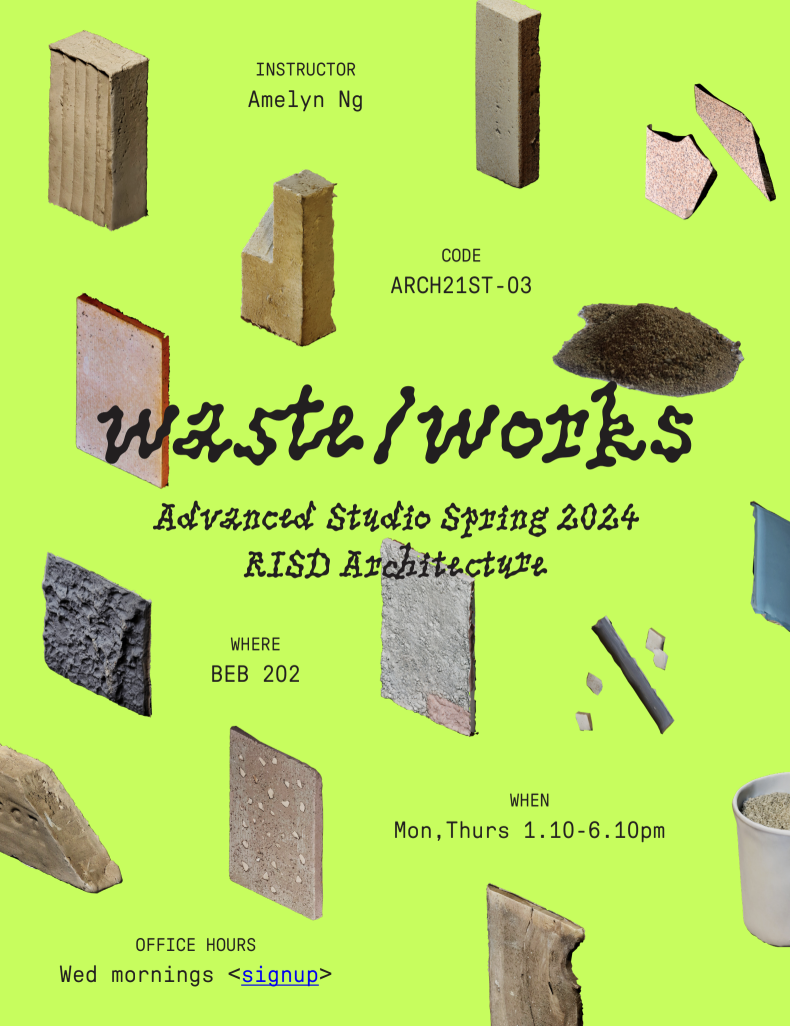
WASTE/WORKS
Advanced Topics Studio
(Mixed graduate and Undergraduate)
Advanced Topics Studio
(Mixed graduate and Undergraduate)
This studio investigates the material, environmental, and social intersections between waste, labor, and the built environment. With a focus on building and urban waste, salvage, reuse, recycling, and regeneration, we will think and work towards just industrial futures in Sunset Park, New York City, amid the climate crisis and cultures of consumption.
We will engage with the RISD Nature Lab this semester for various material ‘cooking’ experiments. Taking resourcefulness as an ethos, the studio expects students to get creative with sourcing, recipes, and low-footprint approaches to model making.
We will engage with the RISD Nature Lab this semester for various material ‘cooking’ experiments. Taking resourcefulness as an ethos, the studio expects students to get creative with sourcing, recipes, and low-footprint approaches to model making.